You find out you're pregnant weeks before anyone can tell you anything
PEEK — Placental Early Evaluation and Knowledge — is building a product to read the placenta's earliest signals in ways that build a positive relationship to the profound change happening in your body.
What we're building
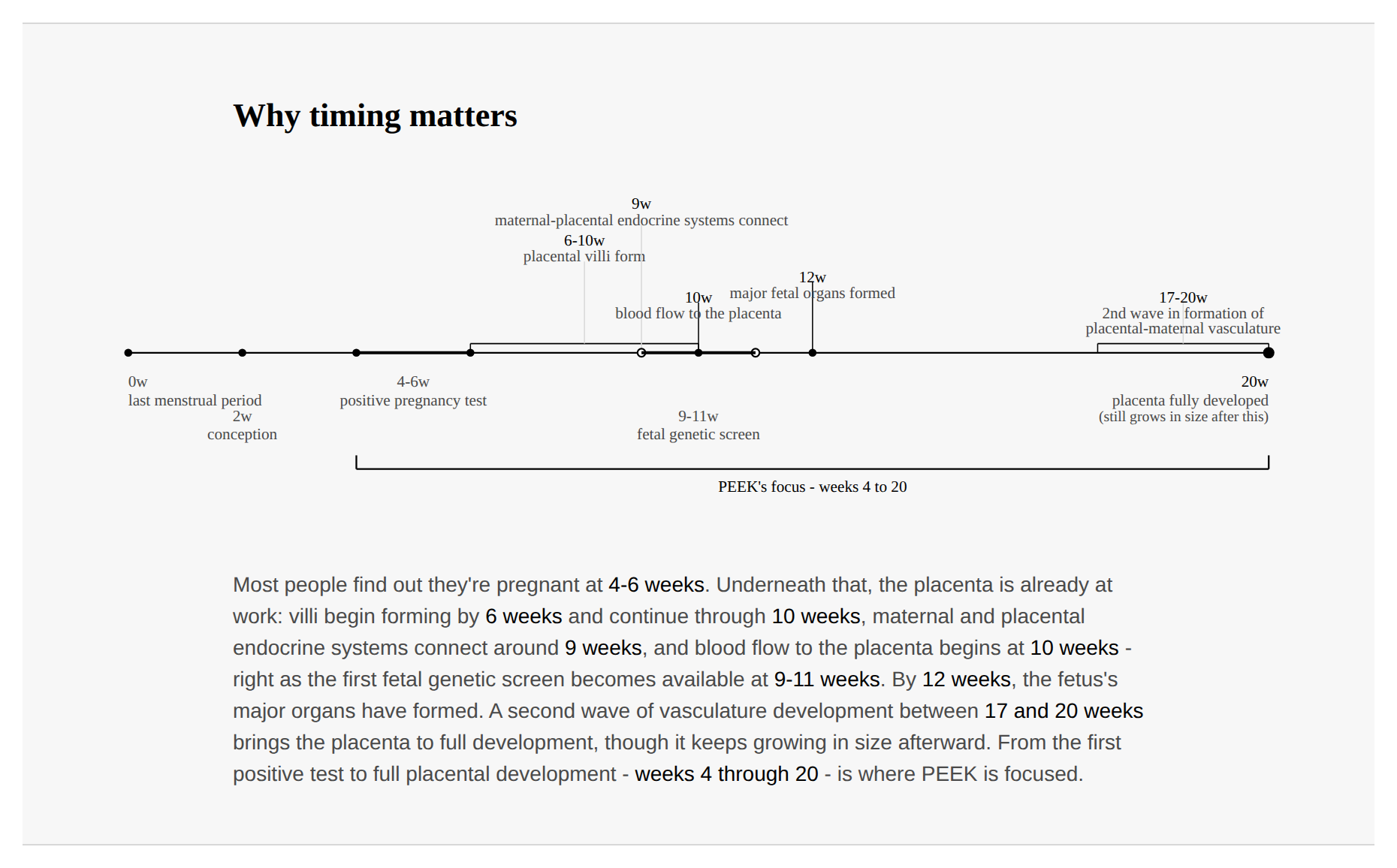
The placenta forms faster than almost any other organ in the body, and it's doing that work during the exact weeks when a person has the least information about what's actually happening inside them. That mismatch — enormous change, almost no visibility — is where a lot of early pregnancy curiosity and anxiety live.
PEEK is building a way to read the placenta's earliest signals during that window, so the wait between a positive test and a first real scan feels less like uncertainty and more like an ongoing, understandable process.
PEEK's vision is a loop, repeated at the pace pregnancy actually moves: measure what's happening in the body, compute what it means, communicate it in language a person can use, and intervene on it immediately.
We measure through the placenta's own proteins and the story the person living through it can tell us. We compute those signals into insight about one environmental factor that can be modified, with potential for positive influence. We communicate that insight plainly, not as a lab report. And we intervene — with a guided step that can start the same day, aimed at optimizing the person's health in ways designed not to harm the placenta, and that may support its growth, development, and function.
Who this is for
Anyone in the first weeks of pregnancy who wants steadier ground under an experience that usually offers none. Clinicians who want a better way to support patients through that early gap, not just monitor for what could go wrong in it.
The PEEK Vision behind the vision
Positive influence, repeated across enough pregnancies, has the potential to add up to something larger than any one pregnancy. PEEK's longer-term vision is to reduce the incidence, by a significant proportion, of adverse pregnancy outcomes that don't have a genetic cause — outcomes that today's care often can't act on early enough to prevent.
That includes hypertensive disorders (preeclampsia, hypertension, stroke), metabolic disorders (gestational diabetes), and a broader group of conditions that tend to sit downstream of stress, inflammation, autoimmunity, and hormonal imbalance — including preterm labor, premature rupture of membranes, cholestasis, intrauterine growth restriction, maternal mortality, and postpartum depression, among others.